
When the store counter isn’t enough
When the store counter isn’t enough
Walk into almost any busy service location and you’ll see the same pattern.
A queue forming.
Staff doing their best to keep up.
Some customers needing simple help.
Others needing specialist support.
Meanwhile, somewhere else in the same network, another location might be almost empty.
Traditional service models assume that every location needs its own full team. But reality rarely matches that assumption. Demand changes throughout the day. Expertise is unevenly distributed. And some locations simply don’t justify having certain specialists on site.
The result?
Customers wait longer.
Staff feel pressure.
Businesses struggle to balance resources.
Bringing the right person to the customer, instantly
Bringing the right person to the customer, instantly
Instead of requiring the right expert to be physically present in every location, video attendance allows businesses to connect customers with the right person remotely.
In practice, the experience is simple.
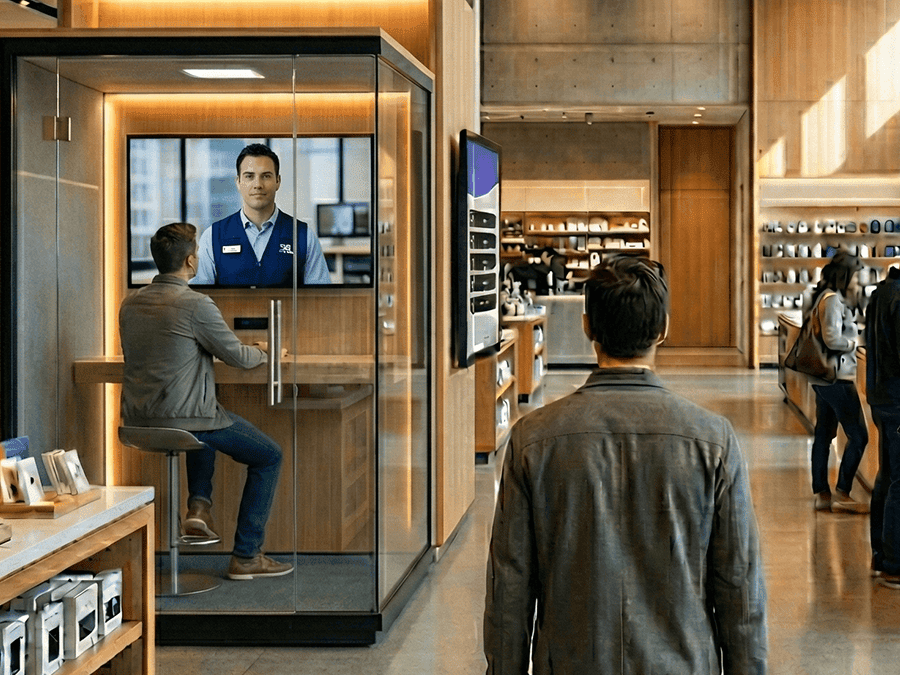
A customer takes a ticket for a specific service. When it’s their turn, they connect to a staff member through a video call, either from a screen installed in the store or through their own phone.
Behind the scenes, the system can intelligently assign the right agent based on predefined rules: service type, language, availability, or location.
Sometimes the conversation stays entirely remote.
Other times, the interaction flows naturally between remote and physical service. A customer might start with a video call to diagnose a problem and then be directed to a physical counter to complete a payment or finalize a process.
The experience feels seamless, but the operational flexibility behind it is transformative.
When one expert can serve an entire network
When one expert can serve an entire network
One of the most powerful advantages of video attendance is that expertise no longer needs to be replicated everywhere.
Take a retail electronics store, for example.
Traditionally, if a customer had a technical problem with a device, the store needed an in-house specialist, or the device had to be sent away for evaluation. With remote video assistance, a technical expert based at headquarters can immediately assess the issue through a live call.
In many cases, the diagnosis can happen instantly.
Only when necessary does the device move into repair or warranty processes.
The result is faster answers for customers and fewer logistical steps for businesses.Extending service beyond physical locations
Extending service beyond physical locations
Video attendance also allows businesses to exist in places where traditional service counters simply aren’t viable.
Think about airports.
There are thousands of airports around the world, and airlines can’t maintain staffed help desks everywhere, let alone keep them open 24 hours a day. But passengers still need help when flights are missed, luggage goes missing, or tickets need to be changed.
With video attendance, that support can exist anywhere.
Passengers take a ticket and connect with an airline agent through a video call, either from a video call box or from their own phone. Even if the physical desk is closed, a real person is still available to help.
Some airlines are already adopting this model in their service centers.
Suddenly, support becomes available in every airport, at any time, in multiple languages.
The physical limitation disappears.
Turning quiet stores into additional support capacity
Turning quiet stores into additional support capacity
Another challenge many businesses face is uneven demand across locations.
One store may be overwhelmed with customers, while another location just a few kilometers away is relatively quiet.
With video attendance, those quieter locations can help absorb demand remotely.
Staff from less busy branches can assist customers in crowded stores through video calls. This kind of dynamic resource allocation - sometimes called smart pairing - allows businesses to balance workloads across their entire network in real time.
Instead of hiring additional staff to handle occasional peaks, businesses can simply redistribute expertise when and where it’s needed.Better experiences for customers
Better experiences for customers
From the customer perspective, the benefits are immediate.
Waiting times decrease because more agents can participate in service delivery. Specialists become accessible even in smaller locations. And language barriers can be reduced by automatically pairing customers with agents who speak their language.
In busy environments like airports or transportation hubs, this can be especially powerful. A traveler who only speaks French, for example, can be automatically connected with a French-speaking agent, regardless of where that agent is physically located.
For customers, the experience feels simple: faster help, from the right person, when they need it.A hybrid model for the future of service
A hybrid model for the future of service
Video attendance isn’t about replacing physical service.
It’s about extending it.
The future of service environments isn’t purely digital or purely physical. It’s hybrid by combining physical presence with remote expertise to create more flexible, resilient service networks.
Counters still exist.
People still interact face to face.
But the walls of the building no longer define where help can come from.
And when businesses can connect the right person to the right customer, at the right moment, regardless of location, that's when something interesting happens.
Service stops being limited by geography.
Presence becomes something you can scale.When the store counter isn’t enough
When the store counter isn’t enough
Walk into almost any busy service location and you’ll see the same pattern.
A queue forming.
Staff doing their best to keep up.
Some customers needing simple help.
Others needing specialist support.
Meanwhile, somewhere else in the same network, another location might be almost empty.
Traditional service models assume that every location needs its own full team. But reality rarely matches that assumption. Demand changes throughout the day. Expertise is unevenly distributed. And some locations simply don’t justify having certain specialists on site.
The result?
Customers wait longer.
Staff feel pressure.
Businesses struggle to balance resources.
Bringing the right person to the customer, instantly
Bringing the right person to the customer, instantly
Instead of requiring the right expert to be physically present in every location, video attendance allows businesses to connect customers with the right person remotely.
In practice, the experience is simple.
A customer takes a ticket for a specific service. When it’s their turn, they connect to a staff member through a video call, either from a screen installed in the store or through their own phone.
Behind the scenes, the system can intelligently assign the right agent based on predefined rules: service type, language, availability, or location.
Sometimes the conversation stays entirely remote.
Other times, the interaction flows naturally between remote and physical service. A customer might start with a video call to diagnose a problem and then be directed to a physical counter to complete a payment or finalize a process.
The experience feels seamless, but the operational flexibility behind it is transformative.When one expert can serve an entire network
When one expert can serve an entire network
One of the most powerful advantages of video attendance is that expertise no longer needs to be replicated everywhere.
Take a retail electronics store, for example.
Traditionally, if a customer had a technical problem with a device, the store needed an in-house specialist, or the device had to be sent away for evaluation. With remote video assistance, a technical expert based at headquarters can immediately assess the issue through a live call.
In many cases, the diagnosis can happen instantly.
Only when necessary does the device move into repair or warranty processes.
The result is faster answers for customers and fewer logistical steps for businesses.Extending service beyond physical locations
Extending service beyond physical locations
Video attendance also allows businesses to exist in places where traditional service counters simply aren’t viable.
Think about airports.
There are thousands of airports around the world, and airlines can’t maintain staffed help desks everywhere, let alone keep them open 24 hours a day. But passengers still need help when flights are missed, luggage goes missing, or tickets need to be changed.
With video attendance, that support can exist anywhere.
Passengers take a ticket and connect with an airline agent through a video call, either from a video call box or from their own phone. Even if the physical desk is closed, a real person is still available to help.
Some airlines are already adopting this model in their service centers.
Suddenly, support becomes available in every airport, at any time, in multiple languages.
The physical limitation disappears.Turning quiet stores into additional support capacity
Turning quiet stores into additional support capacity
Another challenge many businesses face is uneven demand across locations.
One store may be overwhelmed with customers, while another location just a few kilometers away is relatively quiet.
With video attendance, those quieter locations can help absorb demand remotely.
Staff from less busy branches can assist customers in crowded stores through video calls. This kind of dynamic resource allocation - sometimes called smart pairing - allows businesses to balance workloads across their entire network in real time.
Instead of hiring additional staff to handle occasional peaks, businesses can simply redistribute expertise when and where it’s needed.Better experiences for customers
Better experiences for customers
From the customer perspective, the benefits are immediate.
Waiting times decrease because more agents can participate in service delivery. Specialists become accessible even in smaller locations. And language barriers can be reduced by automatically pairing customers with agents who speak their language.
In busy environments like airports or transportation hubs, this can be especially powerful. A traveler who only speaks French, for example, can be automatically connected with a French-speaking agent, regardless of where that agent is physically located.
For customers, the experience feels simple: faster help, from the right person, when they need it.A hybrid model for the future of service
A hybrid model for the future of service
Video attendance isn’t about replacing physical service.
It’s about extending it.
The future of service environments isn’t purely digital or purely physical. It’s hybrid by combining physical presence with remote expertise to create more flexible, resilient service networks.
Counters still exist.
People still interact face to face.
But the walls of the building no longer define where help can come from.
And when businesses can connect the right person to the right customer, at the right moment, regardless of location, that's when something interesting happens.
Service stops being limited by geography.
Presence becomes something you can scale.